How I Conceived the Idea of It Starts at Home

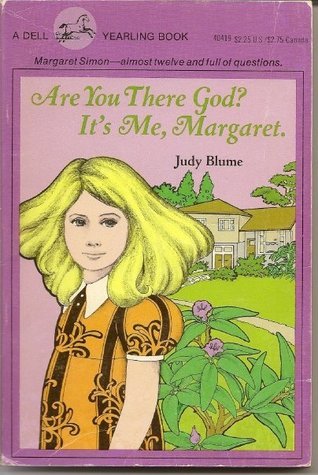
bully-6“My life sucked when I was in high school, so how much worse would it have been if I was a girl?” That was the important question I asked myself after I finished reading Damned and Are You There, God? It’s Me, Margaret.

When I was a teenager, I got into heaps of trouble due to talking back at teachers, retaliating against bullies, and on some occassions I became a bully myself. The kind of bullying that I experienced and carried out fell on the masculine side of bullying. This included, but was not limited to, physical violence and intimidation.

And so due to society’s propaganda against us males being thoughtless violent brutes, I used to think bullying was only a male thing, but no, our supposedly gentle birth giving and nurturing counterparts are not exempt from this behaviour. I am speaking in generalities of course, since typically it is boys who get into fist fights, but the form of bullying girls are capable of can be as equally destructive. It’s just more subtle and harder to spot.

To understand the female psyche, and more importantly that of the teenage female psyche, I took to reading more young adult novels with female lead characters, as well as talking to my female friends, cousins, and co-workers to ask about their experiences of having been teenagers.

50-race-attacks-schools-day-picturebullyingpreventionnow-comI learned about how feminine bullying consisted more of psychological tactics. They employ more verbal abuse through passive aggression, spreading gossip, and public humiliation, thus resulting in the destruction of their victim’s self esteem. By recognizing their victim’s personal vulnerabilities such as their body image and emotional issues, female bullies exploit those weaknesses in order to gain a sense of power.

Why would anyone want to command and demand power in such destructive ways, especially when there are healthier ways to feel and be empowered? The answer is quite simple, but also very difficult to accept. High school students are made to feel disempowered, not only by the prison like structure public high schools consist of, but also by the maltreatment they receive at home.

This is why it’s important for parents take the time to connect with their children as opposed to control them. To use their hands and their words to guide and comfort their children, not to strike or intimidate them. Otherwise, where do you think this behaviour comes from? Children are sponges. They only learn what they live, and devoid of any self awareness or intervention from peaceful people to point out the dysfunction, they will often bring their home life out into the world, particularly at school.

child-abuse

If you are bullied at home, you are likely to become a victim and/or perpetrator of bullying. Either you will walk down the school hallways with slumped shoulders, head bowed in hiding, and sticking close to the walls as to avoid detection, or you will attempt to regain the power you are robbed from at home by mistreating the former.

It’s not set in stone, teenagers do have the choice and capacity to act virtuously, as well as develop the self confidence and healthy support groups in order to ward off bullying–but studies have shown that maltreatment of children sets them up to exude anti-social behaviours and aggressive tendancies later in life.

So why write through a female perspective for my book? Threats of meeting another boy at the flagpole to beat the shit out of him is already such an obvious and apparent form of bullying, but bullying takes on several other forms. Society and the media will usually only touch upon the effect, but not the cause, because fundamentally…

Bullying…starts at home.

Being a Decent Human Being is Hard Work

Conscience Just Ahead Green Road Sign with Dramatic Storm Clouds and Sky.Please forgive me, I’m very new to this whole “being a decent human being” thing. Really, I am. After a decade of intensive self work, I am still prone to lapsing from time to time, and thus will do or say things that are out of line.

I’m not trying to excuse myself from being offensive or sometimes outright shitty, but old habits die hard, and some ingrained habits of mine include saying some outrageous and shocking things. This also includes, but is not limited to being an asshole and insulting someone directly or indirectly.

For instance, when my first writing group criticized a sex scene in my adult contemporary novel (2nd novel I wrote called Me, My Self and Who Am I?)–a fellow writer told me, “they say write what you know, so maybe you should get some experience before you write a sex scene.”

And I replied, “experience? Wanna come over and smell my sheets?”

My college professor placed an arm down on her desk and said, “this is the line,” and then crossed her other arm over it saying “and this is Marlon.”

Everybody laughed, and I got off from it. Yes, pun intended.

I get it, some situations and certain people are open to it, but overall, it may or may not be appropriate in others. I’m left wondering if this part of me is worth keeping alive. It’s been a big part of me and one of the ways I’ve humoured people.

Keeping it or ditching it…that’s something I still need to figure out, but ultimately, I will commit to learning how to put on a bit of a filter for myself around those who may not be able to stomach it or just may be more mature than myself.

I think the reason why I make dark, cynical, and explicit jokes is because being plain ol’ me never got me that much attention. I want to grab at attention by saying shit that shocks and disorients people. It’s fun to see what limits and boundaries I can break sometimes and I wonder to what degree that kind of attention is even healthy for myself or others.

I don’t know…

I constantly wonder if trying to be a better person might include lessening or completely removing such behaviour because I do feel an immense joy in simply being kind, generous, and empathetic, instead of acting like a character from some adult sitcom.

(You know, that kind of character you love watching offend people and laugh your ass at, but would never want to associate with in real life, ie. Sheldon Cooper and Barney Stinson)

Being a decent human being is hard work, but hard work is often associated with having a high reward, and I think it’s even more true than with anything else. You can work hard at running a business, doing your job, or studying for school etc., but I think the hardest work anyone can do and have the highest reward lies in being a decent human being.

Not only are they in high demand in this world, for they/we are very rare, but really do make the world a much better place to have empathetic and understanding people. People who can own up to their actions, self improve, help guide others into similar behaviour (but in their flavour), and overall make the world a little less cruel and disgusting one interaction at a time.

So hey, I’m not perfect. Not yet anyway. And as I write this, one of my favourite songs has popped up on my iTunes by Kacey Musgraves. After everything is all said and done, having done my best to be the most authentic version of myself, “you can’t be everybody’s cup of tea.”

This is me embracing the duality of being genuine and douchey all at once. Take it or leave it.

How I Got Into Young Adult Novels Through Chuck Palahniuk

damned-headline-hi

I used to think that Young Adult novels were lame, because I assumed that you weren’t allowed to cuss or discuss dark and gritty topics. Of course, that’s what happens when you assume things; you make an ass out of u and me. Now that I’ve actually read a ton of YA novels, I am hooked!

And I actually owe it all to Chuck Palahniuk!

Although he writes mature adult novels–full of excessive vulgarity, disgusting details, and overtones darker than the night itself–I got into YA thanks to him. Most of his novels do feature adult characters getting into adult situations, most of which involve some awesome plot twists (Fight Club, Invisible Monsters, Snuff), but there’s one book of his that features a fat 12-year-old dead girl in Hell.

Damned follows the story of Madison “Maddie” Spencer, the daughter of two Hollywood big shots who are constantly too stoned out of their minds to give her any genuine attention or affection. She apparently dies of a mairjuana overdose, and is sent to Hell where she meets a group of other damned souls who become her posse of misfists.

The book is often described as The Breakfast Club meets Are You There God? It’s Me, Margaret in Hell because each chapter begins with “Are You There, Satan? It’s Me, Madison,” and she shares the coming of age struggle Margaret faces in Judy Blume’s book.

Now, I’ve watched The Breakfast Club several times in my life and have always connected with the universal themes of the teenage struggle, but never once have I ever read a Judy Blume book. Why would I anyway? Aren’t her books written for little girls?

Apparently not!

Don’t get me wrong, I love Damned, but the sequel Doomed, felt a little overwritten compared to its predecessor. The narrative voice felt too intellectual and masculine to be that of a 12-year-old girl’s, but I read it anyway because I highly enjoyed the overall adventure of Maddie’s goal to confront Satan and find out why she had to die early and be damned to eternal torture.

(Chuck Palahniuk’s idea of eternal torture includes walking on hills of toenail clippings, passing by rivers of pimple puss and rejected human fluids, and my personal favourite; working at a telemarketing office to troll the people still alive on Earth)

So I got curious about Are You There, God? It’s Me, Margaret just so I can see how much of it actually inspired, or at least reflected the content in Damned. Aside from the chapter openings and having a 12-year-old protagonist, there was obviously a stark contrast that astounded me.

Gone were the supernatural elements, gross descriptions, vulgarity, drugs, and violence etc.

What I got instead was a story about a middle grader feeling left out because she’s the only girl in her class who hasn’t gotten her period yet. That made for a great a surface theme–since I’ve never considered what the female puberty experience was like, though it was a welcomed surprise–but what really captivated me about the book was Margaret’s struggle with her religious beliefs.
It surprised me immensely when I started noticing the bigger picture. Margaret was raised without religious affiliation; her father is Jewish and her mother is Christian–but pushed  neither religion on her–and so Margaret’s internal struggle, on top of her desire to get her first period, was trying to find religious singularity.

[spoiler]There was this epic scene where her grandmother and her parents argue about what religion she should conform to, but she gets so frustrated and cries out about how no one even is stopping to consider what she wants to believe in.[/spoiler]

Although I prefer to read more mature YA novels with older characters who do cuss and discuss dark topics, Judy Blume single handedly diminished my assumptions about YA. Now I have absolute respect for it because it’s now that I understand the appeal to it.

Being a teenager is an intense time in anyone’s life because it’s when we begin to truly begin to question our identities as individuals separate from culture. Our hormones and emotions are the most sensitive and although it’s such a small amount of time in our overall lives, they are the most intense, bringing with it the growing pains that shape us. The teenage experience is universal for anyone who has survived it.

Stay tuned for How I Conceived the Idea of It Starts at Home…

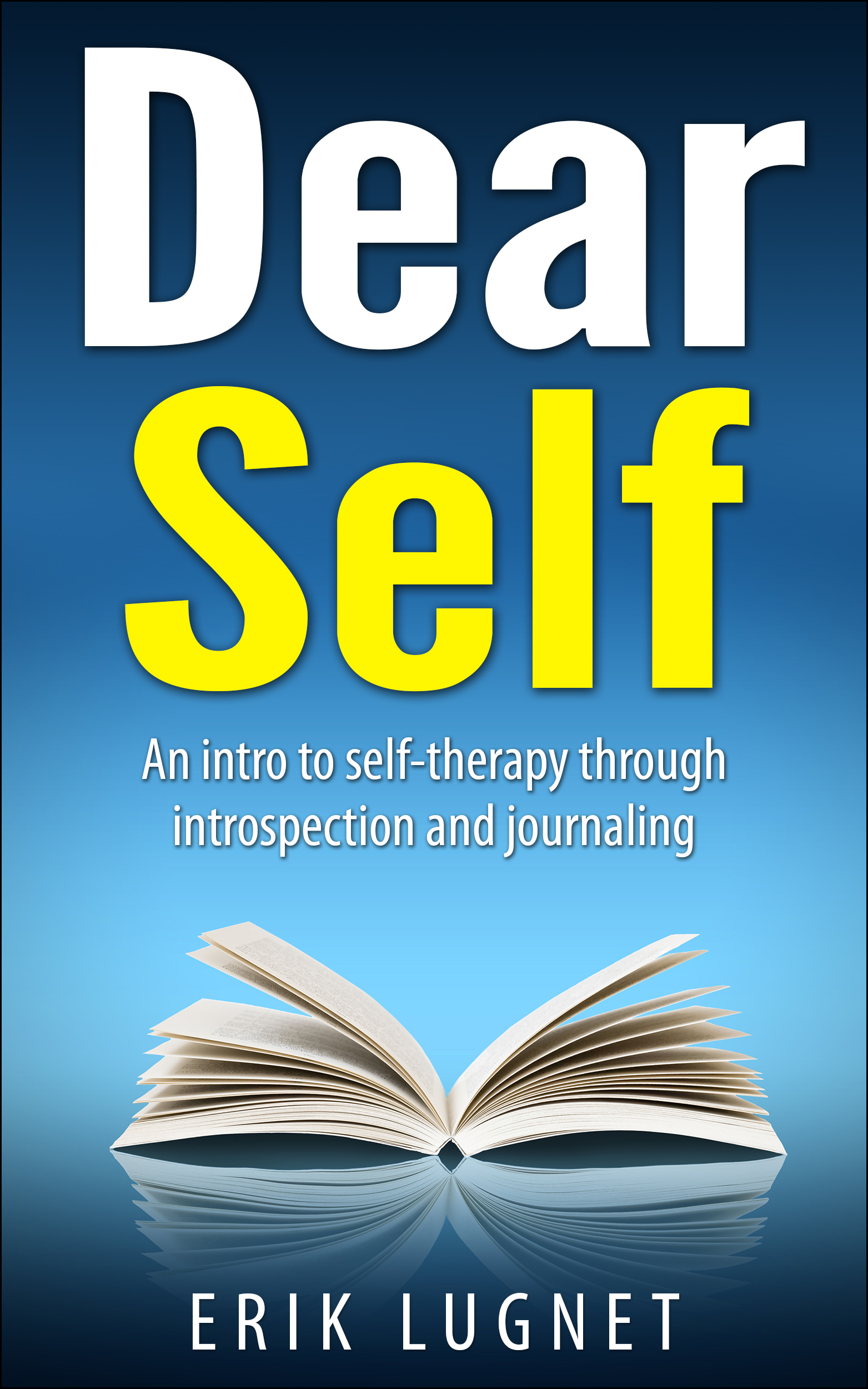
eBook Review: Dear Self by Erik Lugnet

dear self“Life can be difficult sometimes. It is not made easier by the sometimes overwhelming inner voices that criticize us into oblivion.”

So how can one climb out of this oblivion and learn to tame the inner dialogue that plagues many of us, thus preventing us from living happy, functional lives?

There are many answers to this question that require years of time, money, and energy invested into self work through journaling, therapy, and introspection. If that sounds like a daunting task, you no longer have to fear if the investment will be worth it or not.

With Erik Lugnet’s 17 page introduction to introspection, Dear Self gives you a quick and concise glimpse into the world of self-therapy and journaling. If you’re thinking of going to therapy, but are unsure if it may be right for you, this book is a great guide to trying out the process on your own to see if it may be up your alley.

The book begins with a list defining the traits of your True Self. It’s calm, empirical, assertive, honest, empathetic, curious, and compassionate. If you feel that you may have lost these traits due to the hardships of life, Dear Self makes a case as to how and why you could go about reclaiming your greatness.

Erik invites you to be curious and compassionate with yourself, and usually it does help to calm the storm in your head, but that’s not enough. Reworking your inner dialogue can be made easier by journaling and Dear Self briefly touches upon different mediums from the traditional longhand, to audio and possibly video. (What do you think vloggers are doing?) The invitation to write out your emotional experience in a gentle and patient way is possibly one of the simplest, but most powerful suggestions made in the book.

Then of course there’s also a small glimpse of Internal Family Systems to help understand the ambivelance most, if not all of us experience when it comes to understanding our emotions and motivations.

You do not need to be fully educated in the IFS approach to understand this aspect of Dear Self (though itis suggested) because it is explained in such an obvious way. Basically, our entire beings are comprised of different sub-personalities, and Erik’s main principle remains: learn how to approach these parts with curiousity and compassion.

At the beginning of the book, the caveat is put forth that a lot of what is shared is due to personal experience. I didn’t get that impression until much later in the book when Erik begins to talk about specific examples from his real life, most notably in the closing section that barely scratches the surface of the journey he’s been through. I believe that more examples of his own IFS conversations and journaling experience could have enhanced those sections to make the book feel less formal and more intimate, since intimacy with The Self is what this book is meant to promote.

Furthermore, in the section covering where The Self has gone, there is the example of a mother who is easily disturbed by noise, and how that might affect how she would raise her child as just an inconvenience. I think that example could have been fleshed out more if there was a bit more detail about how and what may have caused her aversion to loud noises by going into her history with possibly being yelled at, or witnessing loud confrontations between her parents to drive the point home.

There are also a few misplaced commas and syntax errors a simple re-read can fix, but all in all, Dear Self is a quick and concise read that should help you start on your path to self-knowledge. A revised and possibly a slightly extended version can help work out the kinks of this powerhouse of a debut book.

If you’re still wondering if the investment in yourself is worth it, I would argue that it would be. Because self-knowledge is a fundamental human trait, and without it, how can we possibly know how people relate to us if we don’t even know ourselves?

You can download Dear Self by Erik Lugnet for free at Smashwords, or if you’d like to support my friend and purchase it for $0.99, you can do so at Amazon!


Giving Myself the Write to Live

In the spirit of delving into backstory after my 3 post streak with the Crafting a Character Series, I would like to share with you a personal story of my own.

photocredit: http://www.fanpop.com

When I was 10 years old, I felt so badass for staying up until 3AM to catch a cartoon that looked like it was made with construction paper by a group of kindergarteners.  But the looks were completely deceiving as it would feature some of the most potty mouthed and outrageous content I have ever seen in my life. That show was South Park, and I loved it for its simplistic art style.

I also used to love drawing as a kid, but could never draw anything spectacular or anything close to replicating my favourite cartoon characters. But man, one day I drew a bunch of my own original South Park characters and felt so proud that I could finally replicate something I liked!

I wanted to show this drawing to someone who I used to love and whose opinion I used to value. They will remain as nameless as they are heartless, but basically, this person took a quick glance at my drawings–not a single glance at me–and then said nothing at all before they started using the paper to catch their toenail clippings.

To this day, I’m filled with rage when I recall this instance in my life. The time, energy, and effort I put into this character palette page was wasted to catch the waste of this disgusting individual.

What this communicated to me was that my time, energy, and effort was a waste because no one will give a shit about what I produce. This person was my world and their negligence stained my perception of the actual world at large. It was a bomb set in my brain, ready to detonate in later years, giving me a hard time to commit to creative endeavours.

I’ve always known that I was a skilled writer, and that could I continue to improve daily, but for a long time, I used to require the external validation of others to assure me that my work was worth my time at all. As for drawing, I gave it up in favour of writing and I often wonder if I stopped drawing completely because of this incident–or even without it, I would have naturally made the trade off.

Nonetheless, I’ve been hurt by this careless person and no longer love them, nor do I care about their opinion anymore. At all. Having explored this issue in my history has afforded me the comfort in knowing that the joy I have when I create–a song, a novel, a blog post–belongs to me and only me.

Sure it matters if people like what I produce, but it doesn’t matter as much as how much I appreciate my own time, energy, and creativity.

If anyone ends up liking it, I’m glad that it resonates with them. If they don’t, that’s fine. I’m always open for criticism and improvement, but after processing this aspect of my psyche, I can now tell the difference between whose criticism matters, and whose criticism is just a replication of what was done unto me as a child. At which point, I simply dismiss it as waste. Waste that belongs nowhere near my work.

Keep your waste to yourself because my work will shine as a repellent to your cruelty.