The Four Pillars of Fiction Part 3: Setting

Characters can’t just exist as talking heads in an empty vacuum, they need a setting in which to act out their drama.

And it can’t just be any place chosen at random, it needs to be a specific place that your types of characters would logically exist in.

Maybe you can have cowboys in space, or advanced aliens in the Sahara Desert, if you can make it work and make sense. But typically, you want your characters to match their setting.

CN-Tower

The CN Tower? Where Am I?!

My favourite setting in fiction is contemporary; stuff that takes place in the modern world with our current level of technology and realism. I can maybe do with a few fantastical or sci-fi elements, like time travel therapy in Being Erica, or spy tech in Nikita. But usually no magic, or fancy gizmos for me, and more focus on straight up day to day people whose lives I can relate to.

If I wanted to write a story about what it’s like to move from a small town and into the city, I’d perhaps use Toronto as my setting for my character to experience getting used to the hustle and bustle of a busy downtown area.

Or if you wanted to write a story about magic and wizards you can use Toronto as a landscape for an urban fantasy, or create a world that takes place in something that resembles medieval times.

Either way, if you’ve got a solid plot and a properly fleshed out cast of characters, any setting could work for your story so long as it serves a purpose.

The more elaborate your setting is, the more important it is to have a solid plot and cast so that whatever imaginitive concepts you come up with, they do not detract from the story’s philosophy, rather compliment it instead.
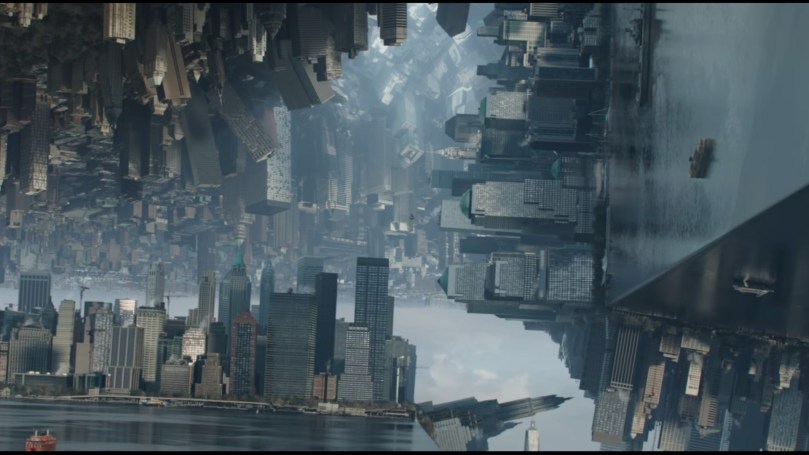
trippy

Setting as Story

Let’s take the film Inception for instance. It’s technically contemporary, but they have technology that allows a group of corporate spies to enter the dreams of their targets to extract information from–and plant new ideas into–their subconscious.

They extract information through their dreams!  How cool is that?! Allow me to geek out about that for a second…

Alright! Anyways.

So the trippy elaborate concept of going into people’s dreams and the dream worlds themselves aren’t just an aside mentioned as a concept in this world. They’re the primary setting and concept that the whole story itself revolves around.

This idea alone, although interesting, would fall flat if there was nothing for us as movie goers to relate to, and so what makes this story so interesting is Leonardo DiCaprio’s character Cobb. He’s the leader of this extraction group, and despite his expertise at his job, he is often haunted by projections of his deceased wife Mal who shows up in other people’s dreams from time to time.

The theme of loss, grievance, and regret is just a few of the many themes in Inception. On the surface, Inception is about this covert group of dream spies trying to help their client take over a competitor’s business.

At its core though, it’s really more about the power of the subconscious and how much it can disrupt our lives if we do not resolve our personal trauma. It messes with us emotionally and interferes with our work and personal lives the way it does to Cobb throughout the film.

The setting is the dream world, and the objective of past pain is manifested in the form of Mal’s projections showing up when Cobb is trying to work in the dreams of people who have no idea who Mal even is. Apparently, working as an extractor, you need to be free of your own mind so that your own mental anguish does not seep into your target’s subsconscious.

Unfortunately that’s what causes Cobb to have some difficulty at his job!

nutshell-cat-page

In a Nutshell

If you’re going to come up with elaborate rules for how the metaphysics of your setting work, make sure that they’re not too convoluted and that they actually serve a purpose in your story beyond making a dude say “whoa that’s trippy!”

The setting and concepts need to compliment the characters’ behaviour and the plot’s objective.

If you have characters who can use magic like the cast of Harry Potter, then the whole magic school setting and the importance of magic should both take focus of the story, as well as mean something to the characters.

If you have characters who know how to use advanced technology, then ideally the world the story takes place in should be advanced enough for it to make sense for such technology to exist. Think Star Trek and Star Wars and how their gear just wouldn’t work in say…Indiana Jones, unless you really grasp at straws for it to work!

Stay tuned for The Four Pillars of Fiction Part 4: Dialogue…
The Four Pillars of Fiction Part 2: Characters

Your story’s objective is only as powerful as the characters that convey it.

Each member of the cast must represent opposing sides of the main argument, thus providing several different angles to perceive your story’s philosophy.

130731-F-IP756-010

I’ve already written a couple of other posts about characters, both of which you can check out here for more:

Crafting a Character Series

Goal, Motivation, and Conflict

–but for today, let’s focus on why characters  should be as extensively explored as I have in previous posts.

Me, Myself, and Who Am I?

Fundamentally, every story’s main character is on a quest to achieve self-knowledge. This goes for both putty characters and pebble characters. Think of throwing a pebble at a wall, the physical structure of the pebble remains the same, whereas throwing a blob of putty will cause it to reform.

That’s what characters experience; being thrown against a wall, so to speak, and they either change or don’t change throughout the course of your story. Either way, their purpose remains the same; to argue for one or several sides of the objective.

I know that there’s a plethora of stories where morality is ambiguous (and that they’re usually much more interesting), but for the sake of simplicity, let’s take the basic concept of Good vs Evil to illustrate how characters argue for each side. And by argue, that could mean verbal or physical combat, or in just the way that they conduct themselves.

Generic Good Guy is a law abiding citizen, doing some good for his friends, family, and community. Everything he does in the story is for the benefit of others or for himself without hurting anybody except possibly…

The Typical Bad Guy whose sole purpose is to watch the world burn. He causes destruction everywhere he goes, expressing his preference to be evil and not care about hurting others because it’s what he intends anyway. Generic Good Guy may hurt other people unintentionally, but he usually owns up to it, while Typical Bad Guy has no remorse for the pain he causes.

In this basic story dynamic of Good vs Evil, the argument is (usually) that good triumphs over evil, all the time.

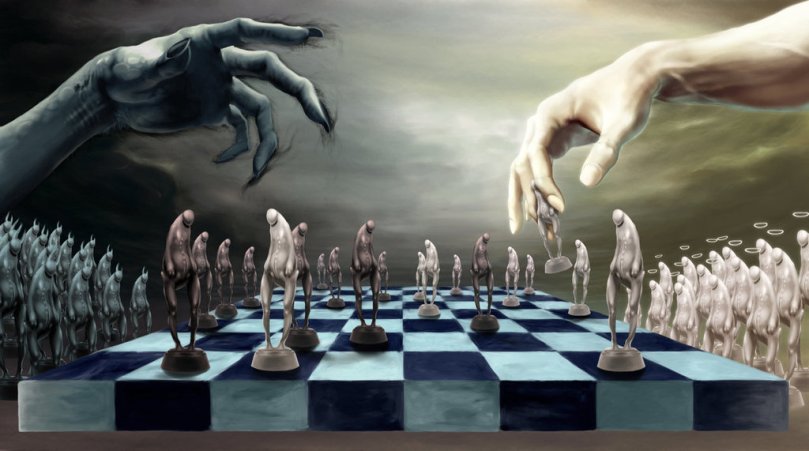
chess_good_vs_evil_by_thewhysoserious91-d5tm81c

Who Would You Be Without Adversity?

To convey this, Typical Bad Guy will have to test Generic Good Guy on the grounds of his ethics, philosophy, strength, and integrity by throwing obstacles in his way. Perhaps Generic Good Guy’s objective is to a safe and adjusted life, but TBG is getting in the way of that by hurting GGG’s social circle and disrupting his day to day life.

It is through adversity where Generic Good Guy will discover or grow into a force for good. If he’s a putty character, maybe he’s a weak underdog type who has to train in order to defeat the almight Typical Bad Guy. Or perhaps he’s a pebble character that has strength and prowess, but hasn’t had the chance to exercise any of it because he hasn’t been challenged yet.

In either case, the end result is the same. The character has developed some level of self-knowledge by fighting for what he believed in, whether he won or lost against his opposition. He now knows what strength he’s capable of, or made himself capable of it through hard work and determination.

Pouring Some Sugar in Generic Brand Oatmeal

Now, that was a very very basic example I had to keep simple in order to elaborate on a more complex concept. Stories these days have many more layers in their examination of the objective, and even more layers in their characterization.

Ultimately, characters are meant to represent several sides of an objective, and they do that by trying to express their personal preferences, only to have them attacked or dismissed by the other characters.

The key ingredient to conveying Objective is having characters disagree with each other and fight over who gets to assert their preference, or if any common ground can be met between them in less black and white type of stories.It is through disagreements between characters that we are given the opportunity to passively experience different sides of an argument–and decide for ourselves which characters we agree with, if any at all.

Stay tuned for The Four Pillars of Fiction Part 3: Setting…

The Four Pillars of Fiction Part 1: PLOT

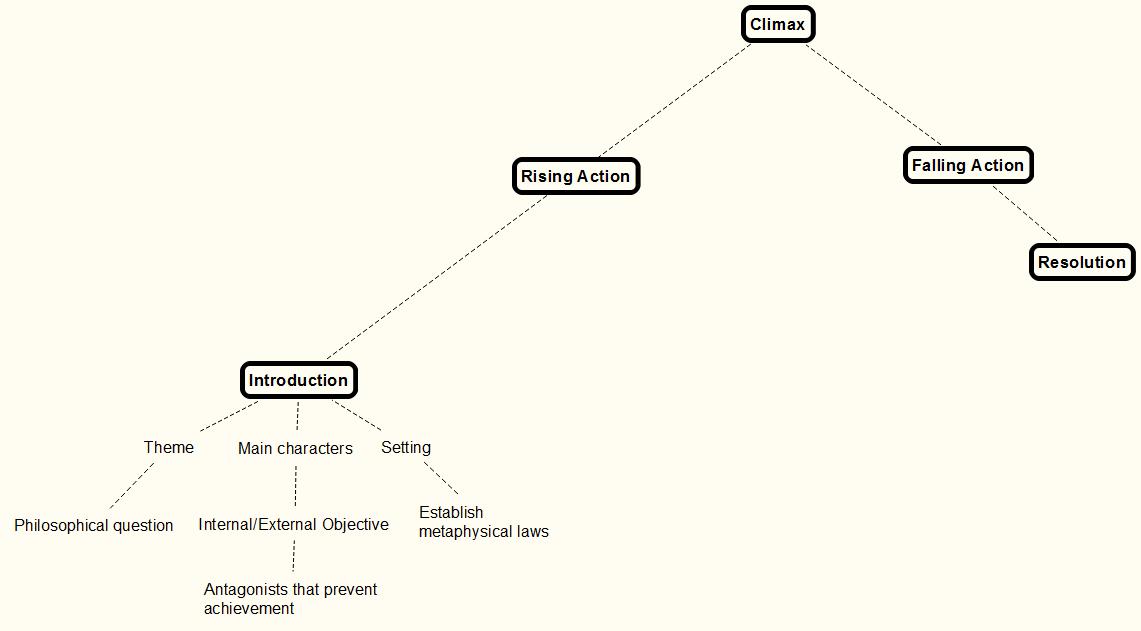
You may be familiar with this basic outline of what a plot graph looks like, and it is nice for writing a basic outline for a story.

Basic Plot

However, this is just a skeleton and we should add some layers to give it some flesh and bone.

What Plot Stands For:

People
Location
Objective
Tenacity

Just like The Four Pillars of Fiction, these are The Four Pillars of Plot that uphold the structure. You need people in a location with an objective to tell a story, along with some tenacity to make that story worth telling.

Fundamentally, you need characters to exist in a physical space in which to act out their drama, and drama only unfolds because these characters have conflicting goals and motivations that prevent each other from getting what they want.

Objective

They may either deliberately want to prevent each other from achieving their goals–as is the case with the simple black and white, good guy vs bad guy stories–or they may even be of the same alliance with differing opinions and preferences that get in the way of them finding unity.

When it comes to your plot’s objective, what kind of message do you want to convey about the world? Is there an aspect of reality you want to capture and illustrate? Is there an ideal version of the world and human behaviour you want to propose? What is it that you want to say about our state as a species?

That is your Objective.

Creators of art, whether they’re conscious of it or not, will always end up injecting their personal philosophy into their work and use it as a tool to convey the different angles in which they perceive people and the world at lage.

There’s no way around it, characters will always have an objective, whether miniscule or grand, they want to accomplish something. Even a story about a guy who just lies around his apartment all day has the objective of…wanting to do nothing and there are some deep rooted reasons beyond “because he just wants to.”

Maybe he’s depressed and doesn’t want to go out, or he’s been out too much and he needs time to himself? Objective in stories are inescapable.

So to add that layer to our basic plot graph skeleton, it should look like this:

Plot With Objective

Tenacity

But that’s still not enough. A story needs Tenacity. Some high (or sometimes low) stakes to keep you at the edge of your seat, biting your nails, waiting to see what happens next.

The rule in life applies to fiction as well: no risk, no reward. The characters need to be at risk of losing something or we won’t be interested in them striving for anything. Surely, there are stories that are risk and conflict free, but with risk comes curiousity. Without risk and conflict, there really is nothing to be gained from it.

We want to be wondering how characters will survive dire situations because we consume fiction to not only root for these portrayals of the human ideal, but also to live vicariously through them. It’s through stories where we can safely experience what it’s like for someone to commit to their Objective and have the Tenacity to achieve it.

Compare these two stories:

“I went to work, did my job because I wanted to make money, and then I came home.”

vs. “I went to work hungover, it was very busy, I could have called in sick, but I need to make rent so I can lie around my apartment all day.”

What’s the fundamental difference between these stories? They both have goals and motivations, but the second one has conflict that requires some overcoming. That’s what we relate to when we experience stories.

This is what a true plot graph would look like with my full PLOT system in place:Plot With Tenacity

I’ll let the graph speak for itself, for there’s much much more to cover in the next three entries.

Let me know if you would like for me to elaborate on any of the additions made in this chart, and I’ll gladly save the exploration of them in a future post.

Stay tuned for The Four Pillars of Fiction Part 2: Characters…


The Four Pillars of Fiction: Introduction

The Four Pillars of Fiction need to be structurally sound in order to maintain your story’s integrity. Each pillar needs to be of equal height and width of the other pillars, or you may end up with a lopsided surface.

But with every rule comes an exception, and there are times where uneven pillars can either work for or against the story. We shall explore the convention of an even structure, and the possibility of leaving one intentionally short within good reason.

4 pillars

Welcome to a four part series where I will be detailing the fundamentals of writing fiction!

Together we will go into great on crafting solid blueprints that will help you develop a firm foundation for your story. Each pillar should seamlessly compliment each other and ultimately deliver a rivetting and captivating experience for your readers.

Part 1: PLOT

The plot is the pillar built from the events in your story. Every scene has a purpose, and every significant plot point must simutaneously ask new questions and reveal vital information about the world and its inhabitants.

Part 2: Characters

Without any characters, there is no story. We need some form of a sentient being in which to experience the world through, as well as relate to in terms of emotionality and intellectual stimulation. I’ve already made several posts about characters, and that very fact alone is reason enough to prove just how important it is to have solid characters in your story.

Part 3: Setting

Likewise with characters, a physical setting is required for a story or your characters will just be interacting in an empty vacuum. The world in which they inhabit needs to exist within the metaphysical laws of your story in terms of its relation to reality.

Magic? Technology? Or just plain contemporary? Whatever your setting is, it must serve as a logical physical playground for your characters to act out their particular drama.

Part 4: Dialogue

We relate and reveal through conversation. What do your characters have to say about the world, themselves, and their situations? To each other? Every character is equipped with their own unique way of speaking that expresses their desires and inner turmoil.

And of course, conversation is not just limited to verbal communication. We will also take a look at how non-verbal communication can serve as a solid substitute for conventional dialogue.

Pack Your Bags For an Adventure

And that is all for a quick overview of what I will be covering in the next couple of weeks.

I hope you are as excited as I am right now to delve into The Four Pillars of Fiction!

Bring your existing tools and be ready to sharpen them, as well as craft several new ones along the way. Together we will build the most structurally sound stories.


Offering FREE Creative Consulting

Digital-Campfire-StorytellingStorytelling.

Think; gathering over a camp fire. Feel the warmth on your skin and in your heart. That is what stories provide us: warmth and connectivity.

Do you have a story burning up inside you?

Want to stoke the flame and tell that story to the world, a small audience–or do you simply want to write something for your eyes only?

If you need help on generating, connecting, and re-evaluating ideas, I can help.

From now until the end of September, I am offering FREE Creative Consulting!

In our sessions we will build your fictional world, or reconstruct your reality onto the page in a stylized and purposeful way. Whether you are writing fiction or non-fiction, we will discover what you truly want to convey.

Together we can create your:

– Plot/Theme/Philosophy

– Characters (their relationships with each other, and impact to the story)

– Setting and its significance to the Plot and Characters

– Dialogue nuances between your characters and any running gags or motifs


I will also be reading your content to give you critiques that will reveal where your strengths and weaknesses are as a writer, and help you reach your potential.

If you want these little embers to erupt into an inferno, drop me a line and we can work out a coaching schedule that works for you!

Add me on Facebook and we can talk!