How to Objectively Measure the Value of Art

You can’t.

It’s all subjective.

See you in the next Meaningful Monday post!

Just kidding, but also not really because although this is how most conversations about art end up, I think it’s worth exploring the conversation killing statement that “art is subjective.” There is a cold hard truth to it that is way more objective than anybody’s subjective opinion could ever be on any piece of art.

Be it a painting, a film, a novel—hell, even video games—anything put out into the world for our consumption and entertainment is subject to being criticized by the masses, assuming it’s lucky enough to reach that wide of an audience. Otherwise, there will always be that dedicated minority who stumbles upon, and actively seeks out, the more obscure art out there to be subject to their criticism.

In today’s post we will explore what it means to criticize art, to converse about it, and to wrap it all up, what art means to all of us at the end of the day. With Your Write to Live being a proponent for fostering creative expression, I thought it would be a good idea to tackle the potentially darker side of creativity where you put your work out there for all to criticize.

Criticizing Creation

First off, I should note that when I say “art,” it is an all encompassing term that refers to not only paintings, but also films, novels, video games, music, and everything in between. Simply put, art is the creative expression of human skill and imagination.

The function of art is to draw attention to certain aspects of the world and the human condition to its audience. Artists do this by being attentive to nuanced details that we may or may not be aware of in our day to day lives. In turn, they highlight these details in their artwork, thus making us hyperaware of these aspects of life that we may not have otherwise noticed, at least not consciously.

A painting can capture how beautifully the sunlight reflects off the surface of a lake, music can capture the sonic expression of human emotion, and a well told story can demonstrate the complexities of human relationships, as well as our unending drive to strive for what we want to achieve in life.

So then to criticize a piece of art is to criticize the world, the artist, and potentially ourselves because of all the thoughts and feelings it may evoke in us. Some pieces of art speak to us while others may not, and there is an endless amount of factors that can affect our experience with every piece out there.

Maybe the piece doesn’t offer anything new or exciting. Maybe it reveals to us that which we do not want to see. Or better yet, a piece itself has been put together so haphazardly that it is hard to tell what it is trying to convey in the first place.

Whatever the reasons are, every piece of art isn’t for everybody. And how can it be? Even when you try to appeal to a mass audience, there will always be those who prefer the more obscure stuff. And on the flipside, there are some pieces of art that—for better or for worse—are so esoteric that only a minority of people will appreciate, let alone understand it.

Depending on what kind of art appreciator you are, you can be veering off to one extreme to another or finding some kind of healthy balance between the both, but at the end of the day, the popularity of a piece does not reflect as a measure for its quality. And even if a small minority of people love a more obscure piece of art with way more passion combined than the masses simple acceptance of what’s in the mainstream, even that becomes a hard thing to measure.

Because how can you measure the value of art?

Criticizing Criticisms

We’ve all had this happen before. We bring up a piece of art that we love and someone else agrees, and together you just go off stating all the reasons as to why that piece of art is “so good.” But then comes along some other person who disagrees and says that that piece of art is actually “bad.” Then maybe you all get a little heated and start arguing over the reasons as to why that piece is “good” or “bad.”

Depending on your debate style and skills, these kinds of conversations usually go in one or three possible ways:

  1. You and the other person endlessly defend your respective opinions and nobody learns anything from anybody.
  2. You and the other person defend your respective opinions and actually start to see the validity of each other’s opinions, while still maintaining your original stances.
  3. One of you actually changes the viewpoints of the other and the opposing party concedes to agree with some, if not all, counterarguments.

If you can achieve outcome number three, I definitely applaud you for your passion and logic because if it is so sound that someone else can finally open their eyes to the light, then hot damn is that a gratifying feeling to have.

And while that’s all well and good, you shouldn’t get too ahead of yourself because at the end of the day, these are nothing but subjective opinions that are barely, if at all, grounded in some kind of objective metric that can measure the value of art.

To beat the dead horse, art is still subjective and it I think I figured out the problem to how you can measure the value of art. It’s something you really can’t do, so the better question we should be asking ourselves is, “why does this person like or not like this piece of art?”

It took me a while to realize this, but basically when someone ever says anything is “good,” or “bad,” it’s just shorthand for “I like it,” and “I don’t like it.” Or to go even further if someone isn’t fully enamoured by a piece of art and they like some aspects, while not liking others, then that’s when you begin to develop a more nuanced understanding of art, and by extension life.

Because art and life are a beautiful cacophony of chaos and order, and a strange balancing act between the two. Not everything can be loved or hated to the most extreme level, or at least for not very long, because nothing is so perfect or so imperfect that there is absolutely no bad or good residing within it.

Art is Who We Are

We are perfectly imperfect beings with so many idiosyncrasies about ourselves that only we may ever truly understand within ourselves. Close friends, family members, or even extremely good therapists can definitely try to understand you as much as they can, but at the end of the day, only you know the true meaning of what any piece of art does for you because of your own unique lived experience.

Anyone who tells you that they know you more than you know yourself is really just getting too in love with their own genius in seeing some of your blind spots for you, but they don’t know the whole story or see the whole picture that is you. If anyone ever makes this claim about you, I would suggest you develop some skepticism and learn to know yourself better so you can learn how egregious that claim can be whenever anybody makes it.

You and only you can truly know yourself. It’s not up to anyone else, but you, and the way in which you relate to art is one of the best ways to get a better understanding of yourself. Begin to ask why you are drawn to certain genres, styles, and themes in art, and you’ll quickly learn what you truly value in life.

If you love horror, perhaps you enjoy confronting your fears head on.

If you love romance, perhaps you’re a romantic person in love with the concept of love itself.

If you love fantasy, perhaps you value the courage it takes to embark on an epic adventure.

Whatever your personal preferences are in art, they speak to you because in a way, they also speak for you, expressing all the inner workings of your being in visual, auditory, and conceptual fashion. You can tell a lot about somebody’s psychological make up based on what kind of art they consume, but again only they truly know themselves enough while you on the outside can only speculate so much about them.

And this is why a lot of conversations about art can devolve into petty debates about what’s good and bad, especially your taste in it. I was like this for a long time too where I mistook criticisms of my favourite art as a criticism of myself, just as much as it would be to have my own creative work criticized as well.

Art is Who We Are and it’s no wonder why we take our preferences seriously at times. I’m not in the business of telling you whether or not you should be offended if someone takes a jab at your favourite stuff, in fact there are some people out there who make it a point to make fun of their own favourite stuff, possibly because being full out positive about it might be seen as too fanboy-ish or fangirly.

But honestly, if you’re in love with a piece of art, paint the town with your love for it because art is what makes life more meaningful and definitely way more worth bearing with. It beautifies our lives with its attention to details we otherwise would not notice had artist not take the time to express themselves and embellish those details.

How Fan Fiction Can Improve Your Writing

For the uninitiated, fan fiction is when a writer takes characters, plots, and locations from already existing stories and writes their own spin on it. From Harry Potter to Twilight, writers across the world have repurposed these stories to their own liking, often reinterpreting the stories in a way that either expands on the lore, or changing up some concepts and plot threads to what they would have loved to see happen in the original story.

Writing fan fiction is a pretty common practice among writers and is often a springboard for writing their own original stories. After all, Fifty Shades of Grey actually started off as a Twilight fan fiction and later became its own original story, which could explain the similarities between the dysfunctional relationships of each story’s respective starring couples.

Now despite fan fiction being a common practice, there are other writers out there who look down upon it because writing fan fiction lacks originality and is considered “cheating.” If you’re one of those writers, you’re not alone, because I was one of them. If you’re a fan fiction writer, maybe this will be a nice refresher or an eye opener as to why what you’re doing is pretty valuable.

The Originality Trap

For a long period in my life, I was overly concerned with being original. I often thought to myself and explained away to others, “why do what everyone else is already doing? I want to stand out, otherwise how else would I ever get noticed?! I want to be original!”

Time and time again, I see a lot of writers and creators get too hung up on wanting to be original because they want to stand out, only to stifle their own creativity because they’re afraid of being a carbon copy of someone else. Having been in that state of mind myself, I can confidently say that this mindset is a surefire way to kill not only your own creativity, but your own confidence as a writer.

This goes for all creators, actually.

Being too concerned with originality could lead to trying too hard to be eccentric and weird to stand out, but then miss out on possibly adding any depth to your work. The harder you try to be original, the more difficult you might make it for others to even comprehend what you’re trying to convey.

This is not to knock on genuinely eccentric work that for whatever reason is difficult to comprehend, and trust me, complexity can be part of the fun in consuming an art piece. It satiates that part of our creative minds that like to think really hard and extrapolate meaning through concerted effort like a puzzle, then feel rewarded once you figured it out, or at the very least created your own interpretation of the piece.

However, I would argue that less is more when it comes to art. This is why a lot of the “simpler” things like pop music and popular fiction can easily be seen as reductive and good for the “uneducated masses.” There’s this huge contention with music where artists tend to start simplifying their music to appeal to wider audiences, and that is often seen as “selling out,” thus leading to people begroaning that “they’re not as good as they used to be.” And, “oh, they just want to make more money so they make whatever the radio stations will eat up like candy.”

In my opinion, this elitist way of thinking of art does a huge disservice not only to ones self, but also the artist themselves that these critics are trying to disparage. Because what if this simplification of their work is actually a byproduct of their genuine desire to change up their style and communicate their message in a clearer way without all the intellectual fluff? Whether consciously or unconsciously.

Again, not knocking genuinely complex and intellectual work. I’m not saying everything should be simplified so everyone can enjoy your work. What I am saying is if you aim to be original you might end up alienating an audience that may have otherwise loved your work regardless of its originality factor.

As consumers, most people don’t really care much for originality no matter how much they claim to. In actuality, people want to connect to a piece of music, a movie, or a book in a way that is personal and intimate for them. No matter how consciously one may claim to seek to be original and only want to consume original work, sometimes the simplest pieces of art become their go to loves for life when they can let go of all expectations and just surrender to what the piece has to offer.

The last thing I’ll say about the Originality Trap is to focus more on what you want to convey—even if it’s been done a thousand times before—in whatever way you feel natural to you. If you have something worthwhile to say, how you convey it won’t matter as much as you simply putting the effort to convey it at all. Any sense of originality and profundity will naturally emerge if you are earnest and honest in your expression, without trying too hard to impress your audience with attempts to seem original and unexpected.

Originality should be the natural byproduct of genuine expression, not a concerted effort.

Learning From the Masters

Originality Trap rant aside, now it’s time to talk about the beauty of fan fiction because it is something I learned how to embrace again recently.

From a consumer’s standpoint, fan fiction can help fans get a little more mileage out of their favourite stories when a fan fiction writer can fill some gaps and provide more closure for a story that may have officially ended long time ago by the original author. We grow so attached to certain characters, locations, and plot threads that maybe we’re not ready to let go just yet, and so fan fiction is usually a good way to extend that story a little more, kind of like how video games now feature mods and downloadable content that extend the lifetime of them.

From a writer’s standpoint, you could be doing yourself a ton of favours by Learning From the Masters. If you are so inspired by another writer’s work that you want to repurpose and re-contextualize your favourite characters in either familiar or new settings, then it’s an opportunity to not only understand their work better, but your own.

Here’s how:

By taking existing characters and writing about them with the conscious, or even unconscious, decision to respect their way of being, you are understanding the nuances of character. If you can accurately write a character in a new situation where readers can say, “that is exactly what they would do/say!” Then you’ve done your job at truly understanding the character’s behaviours and growth from the original series, thus giving you a good insight on how to write your own characters down the line, which we’ll get to a little later.

Then of course, if you choose to build upon an existing plot thread from the story that either left you wanting more because of unresolved issues and unanswered questions, or you see the potential for more storytelling—then once again, doing so can teach you how to understand the importance of stakes in stories and the impact they have on audiences. Not to mention the characters themselves, of course.

Let’s take Cobra Kai, for instance, since I gushed about it in last week’s post about The Paragon of Potential. While this series is an official continuation of the Karate Kid series, the writers of Cobra Kai can easily be seen as fan fiction super fans of the series. Out of all the reboots and sequels in existence right now, in my opinion, Cobra Kai does it just right. There’s a few sprinkles of nostalgia here and there, but fundamentally, the writers have a deep understanding of all the characters and lore the original movie series contained, and so they are well equipped with expanding the universe with a huge new slew of karate students from all the different dojos.

Thirty years later, how would the rivalry between Johnny Lawrence and Daniel LaRusso manifest? This is probably the question the writers asked their selves upon the story’s conception. And to think it might have been sparked by a joke video on YouTube about who the “real” villain of Karate Kid was.

It posits that while we were lead to believe that Daniel, the protagonist for the original Karate Kid Trilogy, was the hero of the series, the true hero of the first movie was Johnny Lawrence. He was an ex-degenerate who just wanted to do better for himself upon his senior year of high school, but Daniel’s presence threw a wrench in his plans by moving in on Johnny’s ex-girlfriend and beating him at a karate tournament he held dear to his heart, thus leading to his downfall in life that robbed him of all confidence and self esteem.

This video was made as a joke, but the points made were so valid that they were probably the catalyst for expanding on the Karate Kid series to the extent that Cobra Kai has done.

Now, likewise with whatever fan fiction you write, if you take in account all these important details about the behaviour of certain characters, the issues they have with each other, and the overall effect their relationships have on the people around them, you can end up writing fan fiction that can make readers feel as though your take is a God honest continuation as if the original creators wrote it themselves.

Or at the very least, you’ve had a ton of fun playing puppet master to your favourite characters and laid down the foundation for characterization which can later inform your own original work down the line.

Taking Creative Liberties

On the inverse, writing fan fiction can also mean Taking Creative Liberties with the property. Maybe certain characters who were never originally meant to be romantically involved can be, if you make it so! Actually, this is the most common thing fan fiction writers do. It’s calling “shipping” because you’re pairing two characters into a relationship that audiences may not have expected. The meme ship has long since sailed with shipping being the sole reason for fan fiction existing in the first place.

But memery aside, of course, you can take creative liberties in other ways such as putting familiar characters in fresh new situations they might not have otherwise been in in the original work they featured in. What would it be like for Harry Potter to get shackled to a boring office job in his adult life, long after his adventures in Hogwarts? What would it be like for the Ninja Turtles to upgrade their weaponry to include guns? What would it be like for—

You get the idea.

These are the kinds of open ended questions you can ask yourself when wanting to re-contextualize existing characters in unexpected settings and situations. By doing this, not only do you expand on your favourite story, but you also expand your own capacity for creativity and originality.

As mentioned before, Fifty Shades of Grey started off as a Twilight fan fiction, but obviously characters and concepts were changed drastically to remove the supernatural elements and replace them with more contemporary concepts, but still maintaining that dysfunctional relationship dynamic Edward and Bella had.

Fan fiction can start of as a blueprint for your own original work when you realize the characters you are writing are no longer the ones you’ve borrowed from an existing piece of work. Maybe then you can change their names, their roles, and traits and make them your own. Likewise with the new plots and locations you come up with in your fan fiction writing. If fan fiction isn’t an expansion of existing work, then they can definitely be used as springboards for original work.

In the best case scenario, they’re both!

And don’t worry…

It’s Not Stealing, It’s Borrowing

Almost all creativity starts with as an imitation of other existing works. That’s what they exist for: inspiration, not competition. Being too fixated on originality gives you the mindset that everybody else’s work out there is your competition, rather than your inspiration. It disgraces what you were originally inspired by because there’s a part of you that aspires to do something just as great as they did to create the impact on others in a way you were impacted by it.

And that’s what the real focus should be when it comes to creativity: impact.

Fan fiction can help you understand its importance whether you consume it or write it yourself. When a story affects you so much that you want to expand on it or write something similar, it’s a beautiful thing. It did its job. And as creators, this is something we must all embrace if we want to stand any chance at ever standing out above the crowd. Because it’s not about how original you can be with your ideas.

The originality will come from how you take existing ideas and repurpose them in the way that shows your own individual style and perception of them. The purpose of an artist is to open the eyes of their audience by hyper-focusing on certain details of life and the world that the audience may otherwise miss. It’s through art that you inspire others to expand on their perception, just as much as fan fiction can help you expand on your own perception of not only the work you’re borrowing from, but expanding on the perception of what you think makes for a good story.

Which in turn allows you to create that original story burning inside of you.

Do you read or write fan fiction?

How has fan fiction benefited you as an audience/creator?

Let me know in the comments below!

Resisting Rejuvenation

For as long as I can remember, I have contended with resistance to expressing my own creativity. This has ranged from writing novels, writing music, and editing videos. I often question how these things I find so enjoyable can also become so difficult to jump back into, especially when it gets to the point where I constantly have to remind myself how good it feels to get into the flow state because I can’t seem to as quickly as I once did when I first started a project.

Couple that with life’s little curveballs and it could be a recipe for disaster. Competing for our attention, there’s work, maintaining an active social life, and other responsibilities that seem to get in the way of our creative self expression. When all of these curveballs are successfully caught, evaded, or even if they end up hitting us in the face, it can seem pretty easy to feel like we just don’t have any energy left to work on any of our creative projects.

The crazier thing is that even when you do have a full day, week, or even a month to do whatever you want, resistance can still creep up on you. I’ve certainly experienced this throughout my life where I’ve had a significant amount of downtime from working, while all these creative projects I know I want to do work on fell by the wayside. Despite remembering the joy these projects brought me, I rationalized that I deserve to sit around all day like a potato, binge watching stuff on Netflix and YouTube, playing the hell out of video games, and then dozing off in the middle of the day when all entertainment options have been exhausted.

If you can relate to this, then I’ve got the solution for you, and it’s actually quite simple. It may seem counterintuitive and pretty obvious in hindsight, but what we must do in the heat of resistance is push through it and get to work anyway.

Even when you’re not feeling it, nay, especially when you’re not feeling it.

Here’s why:

Creativity is Our Life Blood

If you are a creative person with a ton of ideas, with little to no execution of said ideas, you know very well how excruciating it may be to “not have the time” or “not have the energy” to create something. All the while your other creative friends and family members, along with other creatives who have their work put out into the world, are pumping out piece after piece, and you’re stuck staring at a blank page or canvas.

Or maybe you’re not even at that stage, and instead choose to distract yourself with TV and video games, but no matter how hard you try to pay attention to your distraction, the back of your mind is nagging you about that thing you know you should be working on. That project you tell all your friends and family about with the utmost gusto like it would be the coolest thing put out into the world, but you’ve yet to put pen to paper.

Something I learned recently is that creativity actually fuels us, not drain us. You may feel mental and/or physical fatigue from the stresses of life, but actually starting a project can wake your soul back up and bring you back to life. Creative people die inside when they’re not creating because all of these ideas get locked up inside our minds and the overwhelm of having things left unexpressed brings about a ton of anxiety.

The funny thing about anxiety is that it’s really just a bunch of unspent energy. At the psychological and emotional level, anxiety is all about fearing death and being too afraid to act in the face of it. Yes, there’s a sense of possible death when we dare to do something creative because if you plan to put your work out there you risk getting criticized and having said criticism make your work feel like a waste of time. It would hurt to admit your ego was right, that you’re not that very good at the thing you do.

Or if you never plan to put your work out there to share with the world because you’re more of a solitary hobbyist, you can still run up against that perfectionism and potential fear of death. You may be doing it just to entertain yourself, but being your own worst critic and hardest fan to please, what would it say about you if you can’t even entertain yourself?

All these anxieties and more are there because creating art is a risk for the reasons above and more. While valid, you shouldn’t let them stop you from simply expressing the depths of your soul in whatever form you choose.

At the physiological level, anxiety and excitement are exactly the same. That surge of adrenaline coursing through our bodies that makes our hearts race? That’s our body’s way of readying itself for action, and if that action isn’t taken, that energy stays locked up inside and eats away at you.

It’s pretty much the same thing as wanting to confess your love for someone. The longer you keep it in, the harder it becomes to take the next opportunity to do so, all the while just feeling the pain of having something meaningful to you left unexpressed. Art is the exact same way, except it’s you confessing your love for yourself, and by extension, your love for the world and expressing how you see it so others can see it the way that you do.

This is why it is of utmost importance that if you do have a creative project constantly brewing in the back of your mind, that you get to it as soon as you have the time. In fact, I’d say you should make the time. It’s important. It’s in your soul to express it, so instead of creating excuses as to why you can’t or shouldn’t do it, just create the thing to begin with.

Free Yourself From Your Ego

Even when you have “good reasons” as to why you shouldn’t start that project, what it really comes down to is your ego getting control over you. It’s afraid that it’ll die once you start working on something, and so it tells you you’re not good enough to start yet, that you’re not ready, and no one is going to care about what you create, so why bother, right?

If these excuses sound familiar, then it’s time you recognize your ego for what it is and learn how to fight back. If you’ve ever been in a flow state while creating something, you know very well how good that can feel. Time seems to fly by and all your worries go away.

That’s the death of the ego.

The ego wants to stay alive by robbing you of the present moment because all it wants you to do is think about your past failures and regrets, and all the fears you have about the future. Creativity, on the other hand, brings you straight to the present and converts your mind’s proclivity to obsess over the past and future into a wonderful tool.

If you’re writing a novel, then you start to think about what has happened in the story so far and use that to inform the current scene you’re writing, and that’s a useful function of our ability to recall the past. And since novels aim to have an end goal in mind, you also start to think about what needs to happen next as a natural consequence to what you just wrote, and that’s a useful function of our ability to think about the future.

Life only happens in The Now, the present moment. When you experienced the past, that was the form The Now took, and when the future comes, it only happens in The Now as well. This is all we ever have and then seemingly in an instant, it’s gone. So why waste time worrying about the things that have past and things that may yet to be when you can seize the moment and create something that immortalizes your soul for eternity?

How to Achieve Immortality

If it’s the fear of death that stops us from creating, perhaps it’s the very act of creation where we achieve immortality. When you stop to really think about it, all of the artists that have come before us still live on in their work.

Jimi Hendrix’s physical body may be dead, but his spirit lives on in the music he bestowed upon the world. Those tasty guitar licks and funky vocals of his are the encapsulation of his soul at certain points in time of his life. Every studio track and live performance is a record of not only his existence that we can experience from now until eternity, but also the deepest depths of his soul with what he expressed through his music.

You may or may not reach the level of stardom Jimi Hendrix has, but one thing is for certain; if you too create something that is the genuine expression of your being, a piece of your soul will live on in that artwork for all time. Assuming, of course, that you have a means to preserve it and ensure that it remains preserved long after your physical being fades away.

Just having anything created is one step closer to immortality. If you’ve got a painting, a document containing your novel, or a sound file containing your music, that is a piece of your soul you’ve captured for any potential audiences to experience long after you’re gone.

Whether you do it for yourself and/or for the world, that is how immortality can be achieved. To what degree do you want others to remember you by is completely up to you and that’s why there are many services out there that provide ways in which your work can be shared and preserved.

So next time you’re not “feeling it,” take a moment to stop and think. If we’re all destined to be dust one day, why not express what big emotions we have in the very little time that we have?

The Paragon of Potential

The Paragon of Potential in fiction is the character that the protagonist looks up to and aspires to be. Sometimes these Paragons of Potential are mere side characters that the protagonist spends a little bit of time worshipping and seeking guidance from, and other times Paragons of Potential can be well woven into the story as integral to the protagonist’s personal journey.

Expanding on the principles from The Importance of Mentorship, I introduce this idea of The Paragon of Potential so these concepts can be incorporated in both your real life and in your fiction writing. It is my belief that humans are always striving to improve themselves, and what better way to gauge your own self worth than by comparing yourself to someone who already “has it all,” and can have a lot to teach us in how to improve ourselves?

Like in real life, mentors in a work of fiction can serve as an important catalyst for a character’s development, whether they are a momentary afterthought, or a character well baked into the overall narrative of a story. Today we are looking at three characters who are more than well baked into the narrative of one of my favourite shows; Cobra Kai.

The three types of Paragons of Potential in fiction are:

  1. The Perfect Mentor
  2. The Imperfect Mentor
  3. The Flawed Mentor

The Perfect Mentor: Mr. Miyagi

Mr. Miyagi From The Karate Kid training Daniel LaRusso.
Photo Credit: Delphi II Productions

Mr. Miyagi from The Karate Kid is the prime example of The Perfect Mentor. And what makes a good mentor is the student who follows in their teachings because the contrast between student and teacher is often what exemplifies the greatness of a mentor.

So enter in Daniel LaRusso, a hotheaded teen who moves to a new city and new school with his single mother. He is fed up with the unfamiliarity of the new environment and is in desperate need of male guidance to redirect all of his pent up aggression and frustration.

This is where Mr. Miyagi comes in to fill in the role of a bit of a father figure to him, teaching him not just the ways of Miyagi-Do Karate, but also very important life lessons metaphorized by the karate and kata. Mr. Miyagi does this all by remaining Zen, most especially when Daniel expresses resentment toward learning new things that are seemingly unrelated to karate.

For the most part, Mr. Miyagi is The Perfect Mentor because he does not seem to exude any flaws, save for his drinking habits and his broken English. But let’s be honest here, he’s only seen drinking once in the entire film series for a very good and heartbreaking reason, and the broken English makes his quotes all the more epic anyway, so he gets a couple passes over very benign “flaws” if you can even call them that.

Mr. Miyagi is The Perfect Mentor because he teaches Daniel the virtues of potential, patience, and perseverance, while also exuding those virtues himself without fail and without question. Potential meaning the malleability of the human spirit to adapt to any situation. Patience in the sense that that is what is required to master anything. And finally perseverance meaning the tenacity of the human spirit to survive.

Daniel lacks all these virtues at the beginning of The Karate Kid, but by doing chores for Mr. Miyagi that are at first seemingly unrelated to karate, he develops patience and perseverance because he is tapping into his potential. Then once he starts learning karate in the more direct way he was expecting, Daniel is shaped by Mr. Miyagi into becoming a more centered and disciplined young man.

We are all familiar with the whole wax on and wax off scene in The Karate Kid. For a lot of the movie you just watch Daniel doing all these chores including waxing Mr. Miyagi’s cars. Then just when he’s about to get fed up with not “actually” learning karate, Miyagi starts throwing punches and kicks at him, and Daniel is able to block the oncoming strikes.

All the hand motions required for painting fences, sanding floors, and waxing cars ingrained into Daniel’s muscle memory the exact kind of hand motions to block a variety of strikes coming from different angles. That’s the moment all his training clicks and he realizes what all those chores were actually for. It wasn’t just child labour on Mr. Miyagi’s part, he was indeed teaching him karate by not teaching him karate!

It’s an epic and monumental scene, probably one of the most iconic scenes in all of cinema.

Everybody needs a Mr. Miyagi in their lives. Yours and that of your characters in your writing. The Perfect Mentor is the one who practices what they preach and provide a ton of value and guidance to even the most broken of protagonists, showing once again the beauty of the human spirit’s ability to grow and adapt to whatever hardship comes its way.

The Imperfect Mentor: Johnny Lawrence

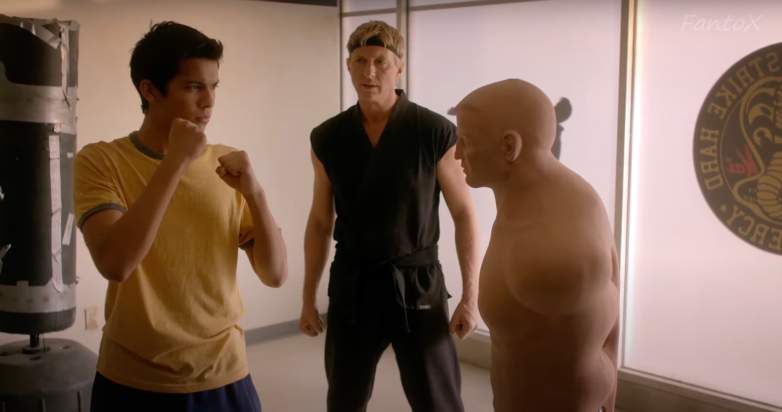
Johnny Lawrence training Miguel Diaz as the only student of Cobra Kai
Photo Credit: Netflix

Up next is The Imperfect Mentor Johnny Lawrence, the original antagonist to Daniel LaRusso in The Karate Kid. Three decades later he becomes the main protagonist of Netflix’s hit series Cobra Kai where Johnny goes on a journey to rekindle his love for karate and redeem himself for his troubled past.

Even from the very first scene we see him in The Karate Kid, we get the sense that he’s just an imperfect person. Johnny’s opening lines are about be an ex-degenerate who is willing to do better for himself for the following years of high school, but his motivation to do and be good is squelched when he sees Daniel chatting up his ex-girlfriend Ali.

In the original movie, Johnny spends most of his time being a snot nosed kid who picks on Daniel and blindly following the advisement of his mentor John Kreese, the original sensei of the Cobra Kai dojo. You really learn how to hate him throughout the movie in the way he terrorizes Daniel, but when Daniel defeats him at The All Valley Under 18 Karate Tournament, there’s a moment of goodness conveyed by Johnny in saying “you’re alright, LaRusso,” and humbly handing Daniel the first place trophy.

Then if you watch the second movie, you start to feel pretty bad for Johnny because Sensei Kreese breaks his second place trophy and starts trying to choke him to death until Mr. Miyagi comes to rescue him. Johnny pleads that he did his best, but Kreese says his best wasn’t good enough, and Mr. Miyagi’s words from the first movie hit ever harder:

“There is no such thing as bad student. Only bad teacher.”

You get the sense that Johnny was only trying his hardest to live up to the pressure Kreese had put on him to be a champion, even going insofar as to agreeing to cheating in the tournament. That was the day Johnny’s love for karate died and Cobra Kai had to shut down since it wasn’t good for business to know that the sensei is willing to assault one of his own students.

Now fast forward 30 years into The Karate Kid’s story timeline into the Netflix series Cobra Kai. Johnny is a broken man in his 40’s with not much going on his life. He’s an odd job repairman with an ex-wife and a son he’s both estranged from, lives in a tiny apartment, and is no longer surrounded by the luxury or loyalty of friends he once had in his golden days of high school.

It was almost as if losing that karate tournament sent him down a dark path throughout his adult years because that’s just how much karate meant to him. Without karate, his life lacked meaning. Not only did Daniel end Johnny’s two tournament winning streak, but his own mentor John Kreese has broken his spirit via nearly killing him for only getting a second place trophy.

One crappy night, Johnny witnesses his teenaged neighbour, Miguel, getting assaulted by a bunch of bullies. At first he tries not to mind them, but then they make a mess on his car, that’s when Johnny steps in. Using all karate he hasn’t used in three decades, he beats up a bunch of snot nosed high school kids to rescue Miguel. Miguel is then impressed by it and gets curious if he could learn some karate from Johnny so he can learn how to defend himself from bullies.

Johnny is reluctant at first, but after some events you just gotta see for yourself by watching the show, he decides to become Miguel’s sensei and open Cobra Kai back up under his ownership.

Miguel is a shy, quiet, and meek kid when he first steps into Cobra Kai, and Johnny being rough around the edges, teaches him how to have a bit of an edge himself instead of always being so straight and narrow. What makes Johnny The Imperfect Mentor is that while he does teach Miguel how to develop some more self confidence and take more proactive action, his methods are often quite aggressive, dangerous, and come from a place of repressed anger.

Johnny knows that life is tough and that to toughen someone up they must face insurmountable challenges that help them grow. While Johnny does teach other meek kids to stand up for themselves and develop self confidence, the first season shows that some of his methods lead to enlarged egos and short tempers because empowering the weakest among us can often mean that they inadvertently end up abusing the power that which they were lacking for so long.

Johnny Lawrence if The Imperfect Mentor because while he does provide value to his students, he can often seem callous in how he does it because some of his motives for teaching them toughness comes from a place of shame and guilt for when he was weak and aimless like they were.

To compensate he constantly insults them, undermines their character, and even creates legally questionable training methods that are meant to teach his students mental and physical toughness like seeing if they can out run rabid dogs and seeing if they can turn a cement spinner from the inside.

Needless to say, Johnny’s approach to teaching karate while not teaching karate is very different from Mr. Miyagi’s calm and peaceful approach of teaching it through safe and honest chores.

The Flawed Mentor: John Kreese

John Kreese and Johnny Lawrence at the All Valley Under 18 Tournament
Photo Credit: Delphi II Productions

Mr. Miyagi said it best, “there is no such thing as bad student, only bad teacher.” And John Kreese exemplifies this to the extreme. This is the kind of horrible mentor you should never want guiding you, but you can become susceptible to falling under the tutelage of if you’re desperate enough.

Case in point with Johnny Lawrence when he was younger.

The Flawed Mentor is the one who does nothing but challenge you. Mentors should challenge you rather than just give undying support because it’s within that challenge that a student can have a safe place to test out their skills. But without a healthy balance between support and challenge, a student might not grow.

If you get nothing but support, you won’t know where you can improve because everything you do is simply seen as good enough and there’s almost no point in being mentored in the first place. The inverse is true as well, if a mentor does nothing but challenge you then your confidence can be crushed and you will always be unsure of your progress as a student.

John Kreese is intense with his methods and teaches: “Strike First. Strike Hard. No Mercy.” A very ruthless approach to karate where the fundamental style is all offense and that the best defense is even more offense. This is discipline in its corrupted form because it leaves no room for compassion, even toward your own comrades, as substantiated in a sparring scene in the original movie:

Two Cobra Kai students are sparring and while one has knocked his classmate off his feet, Kreese advises the standing student to finish him off, and despite the hesitation, he strikes his classmate while he’s down to live up to the “No Mercy” mantra of Cobra Kai.

More of this kind of attitude is shown in Cobra Kai the Netflix series where Kreese instructs his students to be as lethal toward each other as they would to their rival dojo Miyagi-Do. This causes the students to have a very warped and entitled view of karate and the world, that the number one thing in life is winning at all costs. It doesn’t even matter whether you win with honour or not, in fact it’s encouraged to win by playing dirty if you have to.

Life isn’t fair so you should fight all the same, basically.

Johnny Lawrence as a sensei may be rough around the edges and quite aggressive toward his students, but he still fundamentally cares about them as people even though he doesn’t show it much. He reserves most of that for his star pupil Miguel, but otherwise he will throw the odd compliment and inspiring word here and there.

John Kreese on the other hand only pretends to care about their wellbeing so long as they do as he says so it serves him in the end, and that’s the prime example of The Flawed Mentor. One who is teaching others for their own selfish benefit rather than the mutual benefit of human connection and personal development.

Mentors vs Potential

At their core, students are nothing but endless potential to be molded into whatever they so choose and whatever their mentor has to offer them. Mentors can be The Paragon of Potential to them—someone to aspire to—and so in your writing be sure to write your mentors and students in such a way that they compliment each other based on their individual characteristics as seen in The Karate Kid and Cobra Kai series.

If you decide to include a Paragon of Potential/Mentor figure in your story, try and decide which of three main types would be a good fit for your protagonist and their development needs. If you got a hot head protagonist, give them a Zen mentor like Mr. Miyagi. If you got a meek protagonist, give them an imperfect mentor like Johnny Lawrence.

Otherwise, if you want to go deep and dark with a protagonist who wants to be good, but is easily tempted toward the dark side, give them a fundamentally flawed mentor like John Kreese who shows them why they should or shouldn’t succumb to the dark side.

Who are your favourite mentors in fiction?

What kind of mentors have you written in your work?

What are your thoughts about mentors?

Let me know the answers to all these questions and more in the comments below!

Productive Procrastination

Have you ever gotten a song stuck in your head and just couldn’t remember the title of it even if it was at the tip of your tongue? Then went on about your day like normal and just when you thought you’ve forgotten all about it, then suddenly you remember the song title?

This is the power of the subconscious mind. When you try to engage it consciously it often does not yield any benefit because that’s not how this sneaky mental ninja works. It’s actually best to set an intention for something you want, let it wonder in the back of your mind, and allow for your subconscious to work on it in the background.

This is why a lot of creative people come up with their greatest ideas in the shower, while they’re driving, and doing anything else that can be as far removed from the intended activity as possible. And this is also why you might not have to feel too guilty about procrastinating on any creative endeavour, so long as you actually sit down and chip away at it at some point in a reasonable timeframe.

Binging Netflix

When I used to party a lot in my twenties, a common thing people would express guilt about was the amount of Netflix they were watching. Someone would ask, “what have you been up to?” And the response would be, “binging Netflix,” through chuckles that would be an attempt to hide their shame for not looking for a job or enrolling in some kind of post secondary education.

They had this preconception that being an adult meant always being busy and tired, and it actually made me feel kind of sad for them that they did appreciate this mental health break habit a little more than they could have.

The way I saw it was, based on the kinds of shows and movies they were watching, they were passively submitting an avatar of themselves to project onto the screen in the form of the show or movie’s protagonist who would overcome insurmountable obstacles. It’s not that these people were being lazy and doing absolutely nothing, per se, rather they were doing a whole lot while not doing a whole lot at the same time.

They were productively procrastinating.

When we watch our favourite characters contend with the conflict of the plot and other characters in a story, we are seeing ourselves in them and expanding our capacity to see the possibilities in tough situations we may encounter ourselves. To watch our characters grow and evolve, especially when their struggles hit home for us, we are inadvertently learning how to process our own struggles and develop the strength and courage act thereafter.

The thing that would often happen with these people I would run into at parties is that a few months down the line I’d hear that they started going to school or gotten jobs, or if they were already employed and/or educated, they took up new hobbies and interests that enriched their lives.

It was as if they needed those couple of months to decompress and binge watch their favourite shows, much to the dismay of their parents and other people in their lives, including themselves, who were expecting a little more out of them than lazing around “doing nothing.”

As far as I can tell, that Netflix binging period of their lives served as time to buffer while they reoriented themselves physically and mentally, and maybe even emotionally, to reengage with the world when they felt safe and confident to do so again.

The Self Help Junkie

Now, I know what you’re thinking, “how can self help be considered procrastination?”

A lot of people assume that pursuing personal development means personal perfection. That they cannot engage with the world and form relationships until they are absolutely perfect in knowing themselves, and only then will they be able to go out into the world and show that true self that’s been locked away from years of pain and anguish.

This was me for a very long time. I would read every self help book I can and watch all these motivational videos, all the while not really doing much in the real world in terms of seeking employment or even forming relationships with people. Sometimes the feeling of reassurance from the motivational talks and the rush of discovering all these insights about myself was enough to make me feel good about myself and then not do much else with it.

I once had a friend who asked me, “what if all this self knowledge stuff is what’s preventing you from finding a partner?” And at the time my ego came up with the defensive retort, “maybe you lacking in self knowledge is why you always end up in crappy relationships. I want to avoid that by becoming the best me possible so my future girlfriend and I don’t have to suffer through the dysfunctions you guys are experiencing.”

Looking back now, I can see just how extreme and black and white I was in my thinking. I can’t say for sure if what I said about my friend was correct, it’s not my place to really say since only he knows the details of his personal journey as intimately as he does. Anything coming from me would just be a bunch of baseless and defensive assumptions.

But one thing I can say for sure was that he was right about me. For a long time I invested in personal development and thought I knew myself to a T, but you only really get to know how well you’ve developed as a person when you engage with other people and see how this new and improved you actually manages in relationships.

So alas, my arrogance was often squelched by my own set of weird and dysfunctional relationships that gave me a very rude awakening: I really didn’t know myself as much as I thought I did. It only felt like that because I had consumed countless of books and videos about personal development that made me feel good about myself, but without proper application and guidance by a mentor and/or therapist, you can never really know if what you’re learning is even valid.

Which is why as a side note, I highly suggest you hire a life coach and/or a therapist to help guide you through your personal development. No one should have to do it alone, we’re all in this together. And you can have some of the most empathic friends and family who listen to you well, ask you all the right questions, and give you all the reassurance you need.

But the value of a mentor via therapy or life coaching is that this person can have emotional objectivity about you since they don’t have a personal connection to you beyond hired professional and paying client. They’ll be able to see you from an even higher bird’s eye view than your friends and family. A therapist especially, since they know how the human mind works, can really help you understand yourself a whole lot better based on neuroscience and psychology.

Last thing I’ll say on self help is that engaging in personal development assumes you’re flawed in some way, hence your desire to develop personally. But that shouldn’t come at the cost of your self esteem because it’s easy to fall under the trap of perfectionism with it.

Never be too afraid to apply what you learn from self help books, videos, and programs to see if what you’re being taught is valuable. There is no one size fits all solution to personal growth so you’ll have to take and discard principles from varying sources that work particularly for you. And if you also experience a period where you become a self help junkie yourself, see that as a time for you to incubate before you’re ready to hatch and get out into the world.

Mindlessly Browsing the Internet

Even mindlessly browsing the internet can be a source of productive procrastination regardless of the content you’re consuming. Best case scenario is that you are watching things relevant to your goals and learning things, but even if you are just watching cat videos and stupid dance videos on TikTok, there’s always gonna be that voice in the back of your mind that is constantly reminding you of the things you know you should be doing.

Listen to that voice, especially when it begins to get louder and louder over time. It’s crucial. If you try and ignore it, it will definitely be upset with you, but at the same time it will take your intended goals into your subconscious and work it out for you before you engage in the activity you know you could be doing.

If you are consuming content that does educate you on your interests and profession, then great, just make sure not to let it all slip out of your mind without proper application down the line. If you’re watching pointless cat and meme videos, just recognize that our brains don’t always have to be all go, go, go! at all times. Speaking as someone who has ADHD, there is a ton of value in some passive brain activity. We all need the mental break from time to time.

Even as you read this article, maybe there is something nagging at the back of your mind that you should be doing so I don’t want to keep you any longer than I need to. I appreciate your time and attention to read this and hope that you can eventually pick up your socks and do the things you know you “should” be doing.

Final Thoughts

You should still carve out some time to do the thing you know you should be doing. Maybe it’s writing a novel, recording a song, or other responsibilities in life like chores around the house Whatever it is that you’re putting off, just know that as you put it off, your subconscious mind is priming yourself to kick ass at it once you get down to it, assuming you let yourself engage in it in the first place.

But hey, don’t get too down on yourself when you’re procrastinating. Because maybe it’s just the buffer time you need to before you feel ready and competent enough to engage with the world at large.

What are you currently procrastinating on?

Is there a productive outcome from this procrastination?

Let me know in the comments below!