How Being a Wallflower Improves Your Writing

introvert at party
Photo credit: http://happymonsters.tumblr.com

It is a common stereotype that writers are quiet people, and often feel isolated even in a crowd of people out in public. While this is a generalization, and I know that there are some charismatic and extroverted writers out there, their introverted counterparts and extroverted writers themselves can benefit from being wallflowers.

Wikipedia defines it as: “A wallflower is someone with an introverted personality type (or in more extreme cases, social anxiety) who will attend parties and social gatherings, but will usually distance themselves from the crowd and actively avoid being in the limelight.”

Wikipedia goes on to explain how wallflowers would much rather observe a social setting than engage in it, and this is where today’s writing tip comes in. You don’t have to suffer from social anxiety or introversion–as if it’s something to “suffer” from, as most people come to believe–in order to utilize today’s writing tip.

Whenever you find yourself out in public in a moment of silence, take note of how people behave and what the setting looks like. You can either write this down in the notepad of your mind, in an actual travel sized notebook, or even on the notepad app on your smartphone if you have one.

What this will do is give you a myriad of ingredients you can use in future writing. Even if some details never make it on the pages of a manuscript, it still helps to get the mental exercise flowing in order to sharpen your ability to observe and absorb. Here is a list of things to pay attention to and take note of:

For People

  • How do they express themselves physically? Do they use grand hand gestures and speak loudly, or do they move minimally with hushed tones?
  • What are they talking about with their conversation partner? How excited or bored are they in engaging in this conversation?
  • Take note of the contrast of these two “characters,” if there are any.
  • What kinds of clothes are they wearing and are their wardrobes congruent or juxtapositional to their behaviour? Maybe they’re wearing fancy bowties and suits while swearing like sailors, or sporting some baggy low riding pants and talking like gangsters.
  • Pay attention to physical and verbal ticks. What kinds of words do they use often and what noticable movements do they make? Maybe they like to say “like,” a lot like it was like a comma. Or maybe they tend to rub their eyes with the heel of their palm whenever they are disagreed with in conversation.

Just remember to keep in mind that you shouldn’t watch too hard or they’ll find it creepy. Best to use your peripheral vision and pretend not to be listening. Since it’s none of your business what they’re talking about, you don’t want to eavesdrop too much. Just enough  to notice a few patterns.

For Settings:

  • Inspect the architecture of your surroundings. Is it all brand new and recently constructed, or has this place existed for quite some time? What are some details that give away its age? This can range from burn marks in the cement from too many smokers having step foot upon it, to smooth and undented walls.
  • How does it feel to be there emotionally and physically? Is it cold or warm? Do you feel comfortable or uncomfortable?
  • Are there any noticable scents or odours pervading the air? If you’re at a restaurant, perhaps the aroma of fried chicken triggers your gut to hunger for it, or if you’re in a warehouse the stench of dirt makes it hard to breathe to the point of even tasting the duskiness of the environment.
  • And here’s my favourite: close your eyes and pay attention to the sounds that surround the environment. Is it noisy or quiet, or even somewhere in between? If you’re at a mall, pay attention to how assaulted you are with different radio stations playing different types of music as you move from store to store. Or if you’re at a cafe, notice the low hum of patrons conversing or that university student’s fingers click clacking against their laptop keyboard as they rush to finish an overdue paper.

And as my last point was about to do there, a story then begins to take place. Whether it’s a story you’re inventing in your head or a story that is unfolding right before your very eyes, noticing all these details will help you craft more detailed scenes in your writing. We don’t notice details until they go missing, and the mark of good writing is incorporating them in a way that integrate into the scene without drawing too much attention to itself, rather they help embellish the main focus of a story which is human interaction.

Being a wallflower has its perks (no pun intended in reference to the YA novel). Chances are people around you will leave you to your own devices and you can take the opportunity to jot down details of your environment in order to build your vocabulary and the wide range of possible ideas you can use in your writing.

Have you ever paused and taken a social situation in as a silent observer?

What kinds of details and sensations have you gleaned for doing so?

If you haven’t been in wallflower mode before, how does this whole suggestion feel to you? Let me know in the comments below!

Your Novel in One Chapter

fightclub17.jpg

When I go shopping for a new book to read, I like to open potential purchases to the halfway point and read whatever I stumble upon. Why that’s madness, you must say, how will you know what’s going on dropping in the middle of all action? You need to start at the beginning! 

I assure you that I at least flip a few pages back to make sure I’m reading at least the beginning of that midway chapter. I’m not a monster.

My reasoning behind this is because I want to know if the author is able to maintain a strong focus on theme, characters, and plot throughout the entirety of their novel. Something always needs to be happening that not only progresses the story, but also encapsulates the spirit of all that has transpired so far.

Simply put, every chapter in a novel should encapsulate the entirety of the novel in and of itself so that if you were to isolate any chapter from the novel it belongs to, it can read like a self contained short story.

One of my favourite books actually started off as a short story that then became a much later chapter in the full novel of Fight Club by Chuck Palahniuk. It’s the chapter where The Narrator shows up to work with cuts and bruises on his face after having fought in a fight club the night prior, and nobody at the office has even the slightest nerve to ask what happened to him.

This is such a great story in itself because it raises so many questions and depicts something completely out of the ordinary. Despite it being very minimalistic in its narration, it is actually a very jam packed experience.

What I personally love about Fight Club and Chuck’s work in general is the ability for his stories to tell a lot without saying much. It’s pretty much implied how bored The Narrator is with his 9-5 job and life in general if he’s willing to get beaten to a bloody pulp at a late night underground fight club, and not even call in sick the next day.

Encapsulating a Novel Into One Chapter

Basic Plot


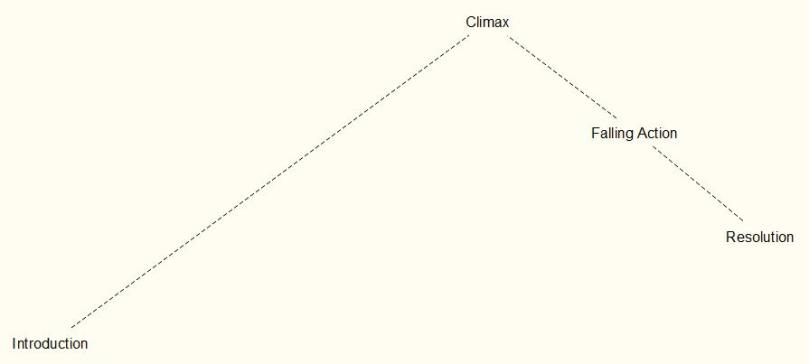
So this is a very basic plot line graph commonly used to organize the entirety of a novel. It helps you introduce your characters, settings, and themes, and build toward a climactic moment that defines the whole story. This allows you to easily detail the story into three acts: beginning, middle, and end.

What I’m proposing is structuring your chapters in the very same way as if that chapter defines your entire novel if it were to be taken at face value. This way your story has a strong emphasis and focus on what it’s all about at all times, with very little time allotted for the story to drag for a moment.

And that’s not to say that pacing wise stories aren’t allowed to slow down, of course they are, that’s when some details get the time to sit and simmer with the reader. Likewise, if a chapter is short and quick paced, the very little details you provide should still be just as fleshed out with knife like concision, very much like the original short story that later gave birth to Fight Club.

In order to create a well focused chapter, even to you pantsers out there, I highly suggest using a chapter graph that divides chapters into three scenes, and even having those three scenes divided into three mini acts of their own like this:

Chapter graph

Every chapter you write won’t have a clear cut structure like this, and like some rules, you might break these guidelines from time to time, but generally this is the structure that ensures your chapters can also function as self contained short stories.

Click here to download your FREE Chapter Graph!


My Write to Live

blood on paperWhen I was a teenager I had suicidal thoughts, and on some unfortunate occasions, suicidal tendencies. I was bullied by the other kids and wanted to turn to the school staff for help, but most of the teachers I had were authoritarian tyrants or simply uncaring of my well-being. A vice principal I once had talked at me with throwaway advice without taking any time to understand how I truly felt. That same vice principal would later in the year fail to prevent a fist fight I got into, even though I had provided him a ton of evidence it was going to happen. Needless to say, I didn’t have the school staff’s trust because whenever I would defend myself from bullies, I would be the one who would get in trouble and shamed for my behaviour, for my emotions. With nowhere to go and no one to turn to, not even my own family, I felt completely and utterly alone.

Or so I thought.

One of the few things I would find solace in was the music of Korn, along with other angsty nu-metal bands, but Korn was my all time favourite since I was a kid. I related to the raw frustration Jonathan Davis’ lyrics were written with and they inspired me to write some of my own in the same vain. Whether the lyrics were about the bullies I wanted to take down, the girls who rejected me, or the general feeling of emptiness by the end of the school day, I wrote lyrics to release these feelings somewhere safe where I wouldn’t get in trouble or be shamed for my behaviour, or my emotions.

Fast forward to my adult years, there was a time where my life was falling apart far worse than I had experienced in my teen years. To name very few issues I had out of a myriad of others, I was getting into intense fights with my family, had to leave a writing critique group due to fundamental philosophical differences, and worst of all found out that an ex-girlfriend of mine had committed suicide.

It was August 2014, I was unemployed and directionless. I had very little money left from a caregiving job I was severely underpaid for and felt empty. Now having grown up and survived my adolesence, I no longer contemplated suicide, especially considering the tragedy of my ex-girlfriend. I no longer cut myself and no longer imagined myself beating my chest until my heart gave out, but I still felt like my life was meaningless and that I didn’t have much reason to live.

Not until I journaled about everything that has been going on for me at the time. Not until I remembered that I had a half finished 2nd draft of a novel just sitting on my computer left untouched for many months. That novel of course was It Starts at Home, the very same anti-child-abuse themed novel that I had fundamental philosophical differences about with my writing group, likewise with my family, both of which, of course, are stories for another time.

For many months after leaving my writing group, I felt discouraged from ever writing again. But when I got back into it and got on my way to completing the second half of the 2nd draft, those feelings of inadequacy and meaninglessness disappeared. Those feelings of regret over my existence were all gone as well, for I rediscovered the joy and meaning I found in writing this story. Sure I picked myself up, applied for work, and got two jobs I put a ton of passion into, but they could never compare to my true calling. My true calling that I drowned out with the noisy distraction called “work.”

Of course! The answer to the question “what am I gonna do with my life?” has been right in front of me all this time, right under my nose, hiding in plain sight: I need to write.

And I stress the word need because writing is a necessity to my life just as much as blood is. To me there is no difference between the blood that drips through my veins, and the ink I bleed on to the page.

I was born a writer. Even when I was as little as seven years old I would skip school to write stories and draw comic books. I’m in love with stories. Whether they’re acted out in a TV show or film, printed in a book or set of lyrics, stories are what makes my life worth living. Not to mention the stories of our lives as I also find a great interest in the real life stories of those around me. All of our lives on this planet are a bunch of stories complete with their own twists and turns, character development arcs, and crossover narratives.

Stories, in any form, help me feel like I’m not alone. To know that others feel the same way I do about life and the human condition, that makes my habitual confusion and anxiety managable. From the lyrics and books I’ve read, movies and TV shows I’ve watched, all my favourite stories have resonated with me on an emotional level. They put the storm in my head into words and action, sequenced in honely crafted narrative that express the growth of character and the universal human desire to overcome life’s many obstacles.

As a writer, this is what I want to achieve. I want to strike a chord in those who read my lyrics, comfort those who will read my books, and let them know that all these confusing and conflicting emotions are all part of simply being human, and although there is no cure to them, they can be managed and understood.

As a writing coach, this is what I want to inspire in other writers. I want to help other writers, as I’ve painstakingly helped myself, to realize the power they have in putting their innermost vulnerable thoughts into the written word. The power to make readers, like myself, feel a lot less alone when life gets them down and when meaning seems all but lost.

The written word is My Write to Live.

It’s Your Write to Live.

The Four Pillars of Fiction Part 4: Dialogue

So you got your plot, your characters, and the setting?

All that’s left to do is make these people talk, and following in the principle provided in this blog series, what they think and say needs to serve a purpose.

RM_05.15_ff_riskdialogue

Why Don’t You Say it to My Face?

When characters speak in fiction, it is meant to resemble a more concise version of human interaction. It subtracts the filler pleasantries and zooms in on the most important aspects of a conversation, and so any small talk topics like the weather and sports should be exempt from dialogue.

Unless, of course, weather and sports are important aspects of the story…

Otherwise we love experiencing fiction because we get to eavesdrop on people’s most vulnerable conversations.

Sound creepy? It kinda does, but these characters aren’t real!

Or are they?

Well, they are only as real as you can portray them in terms of their emotional reactions to their interactions with each other and the world you created for them.

Dialogue should reveal four things:

  • Plot
  • Setting
  • Character
  • Relationship

To reveal plot, characters need to talk about the central theme and objective in a way that lets you in on the most crucial concern in their world. Perhaps it’s poverty in a post-apocalyptic world, and so the characters will talk a lot about how there’s a shortage of food and shelter after some devastating event that destroyed their world.

Everything they talk about should be about survival and rebuilding their society. In doing so, they also get to reveal the setting since it serves as a backdrop for the plot.

Along with exposition and narrative, talking about the place they live in is another way to help describe the setting. As a viewer, we will see their world in a certain way, but it’s interesting to see when a character’s views contradicts ours.

Perhaps the post-apocalytpic world might seem bleak and hopeless to us, but the inhabitants and the way they speak can reveal how much hope they have in their own survival. Furthermore, it can reveal what kinds of bonds are created in such hardship.

As Long as We’ve Got Each Other

conversationSo on top revealing plot and setting, dialogue must also reveal character. When people talk, they are always revealing what they think and how they feel, whether they intend to or not. It’s inescapable. Each person is equipped with their own unique way of expressing themselves in terms of what they value and what they want.
Now it’s tricky because you don’t want your characters blatantly saying “we live in an apocalytpic world and starve every day.” You have to find a way that makes it sound natural, much like every day conversation, but of course remembering to always keep it concise and in relevance to the plot.

Life would be much easier if people were more direct and honest about how they feel and why they have those feelings, but we usually end up expressing all that in different ways that can be interpreted in different ways since we all have our own subjective experiences and opinions.

Because we all have such differing preferences and opinions, we often end up in arguments revealing what we all expect of each other and the world, thus revealing how we relate to each other. Where we differ and where we have commonalities is the bridge between two people, and there’s a push and pull dynamic that occurs in fiction and in real life.

We often want people to like the same stuff as us, but without the difference of opinion we would not have the privilege of being challenged to re-evaluate our values, feelings, and beliefs.

And that is the very point of fiction; to allow us to safely and passively experience a manifestation of our inner clash of values played out to us in another real with its own metaphysical and epistemological laws. With characters who represent different sides of ourselves and we get the chance to pick and choose, based on the consequences of their actions and interactions, what values and beliefs we must keep or discard–all done in a way that entertains us while informing us.

Semi-Final Words

Thus concludes The Four Pillars of Fiction series, thank you for your time. Let me know if these posts have been helpful and if you have any feedback or criticisms on how to possibly improve future and current writing tips, let me know! I’m always more than happy to hear your thoughts whether they’re simple kudos, questions, or criticisms.

Stay tuned for The Four Pillars of Fiction BONUS Post, where I will be using my own novels as examples for each aspect of fiction covered in this series…


The Four Pillars of Fiction Part 3: Setting

Characters can’t just exist as talking heads in an empty vacuum, they need a setting in which to act out their drama.

And it can’t just be any place chosen at random, it needs to be a specific place that your types of characters would logically exist in.

Maybe you can have cowboys in space, or advanced aliens in the Sahara Desert, if you can make it work and make sense. But typically, you want your characters to match their setting.

CN-Tower

The CN Tower? Where Am I?!

My favourite setting in fiction is contemporary; stuff that takes place in the modern world with our current level of technology and realism. I can maybe do with a few fantastical or sci-fi elements, like time travel therapy in Being Erica, or spy tech in Nikita. But usually no magic, or fancy gizmos for me, and more focus on straight up day to day people whose lives I can relate to.

If I wanted to write a story about what it’s like to move from a small town and into the city, I’d perhaps use Toronto as my setting for my character to experience getting used to the hustle and bustle of a busy downtown area.

Or if you wanted to write a story about magic and wizards you can use Toronto as a landscape for an urban fantasy, or create a world that takes place in something that resembles medieval times.

Either way, if you’ve got a solid plot and a properly fleshed out cast of characters, any setting could work for your story so long as it serves a purpose.

The more elaborate your setting is, the more important it is to have a solid plot and cast so that whatever imaginitive concepts you come up with, they do not detract from the story’s philosophy, rather compliment it instead.

trippy

Setting as Story

Let’s take the film Inception for instance. It’s technically contemporary, but they have technology that allows a group of corporate spies to enter the dreams of their targets to extract information from–and plant new ideas into–their subconscious.

They extract information through their dreams!  How cool is that?! Allow me to geek out about that for a second…

Alright! Anyways.

So the trippy elaborate concept of going into people’s dreams and the dream worlds themselves aren’t just an aside mentioned as a concept in this world. They’re the primary setting and concept that the whole story itself revolves around.

This idea alone, although interesting, would fall flat if there was nothing for us as movie goers to relate to, and so what makes this story so interesting is Leonardo DiCaprio’s character Cobb. He’s the leader of this extraction group, and despite his expertise at his job, he is often haunted by projections of his deceased wife Mal who shows up in other people’s dreams from time to time.

The theme of loss, grievance, and regret is just a few of the many themes in Inception. On the surface, Inception is about this covert group of dream spies trying to help their client take over a competitor’s business.

At its core though, it’s really more about the power of the subconscious and how much it can disrupt our lives if we do not resolve our personal trauma. It messes with us emotionally and interferes with our work and personal lives the way it does to Cobb throughout the film.

The setting is the dream world, and the objective of past pain is manifested in the form of Mal’s projections showing up when Cobb is trying to work in the dreams of people who have no idea who Mal even is. Apparently, working as an extractor, you need to be free of your own mind so that your own mental anguish does not seep into your target’s subsconscious.

Unfortunately that’s what causes Cobb to have some difficulty at his job!

nutshell-cat-page

In a Nutshell

If you’re going to come up with elaborate rules for how the metaphysics of your setting work, make sure that they’re not too convoluted and that they actually serve a purpose in your story beyond making a dude say “whoa that’s trippy!”

The setting and concepts need to compliment the characters’ behaviour and the plot’s objective.

If you have characters who can use magic like the cast of Harry Potter, then the whole magic school setting and the importance of magic should both take focus of the story, as well as mean something to the characters.

If you have characters who know how to use advanced technology, then ideally the world the story takes place in should be advanced enough for it to make sense for such technology to exist. Think Star Trek and Star Wars and how their gear just wouldn’t work in say…Indiana Jones, unless you really grasp at straws for it to work!

Stay tuned for The Four Pillars of Fiction Part 4: Dialogue…